A place to sit back, hang out, and make monkey noises about anything you'd like.
Dying in Hell and Buddhism
yesterday
Mouse, you may enjoy Herman Hesse's Siddharta. It's a book I've been meaning to read, and I think it's a novelization of the life of Siddharta Gautama.
The Dhammapada is also a good one. Again, haven't read this myself, but there's a translation by Eknanth Eswaran, a scholar I respect immensely and have a hardcover copy of his Bhagavad Gita, so I figure it's probably really good!
Dying in Hell and Buddhism
yesterday
I've just been browsing various online places in a not especially organized way as far as that all goes. I'm about to start reading the Bhagavad Gita though since I've decided Hinduism is far more based. (It has many of the same concepts while also keeping the idea of a universal god and individual self, which Buddhism is lacking. So the ultimate goal of Buddhism seems kind of depressing to me.)
Dharmic religions don't have any central authority though and some details kind of just evolve organically depending on region. Although Hinduism doesn't seem to spread out of India really which I'm guessing has to do with it being tied in some ways to the caste system? (RK probably has more insights on that of course.) Westernized/modernized Buddhism conversely did a much better job of that, but may also be considered by some to be the faggiest thing ever?
Dying in Hell and Buddhism
16 hours ago
And also this one, holy fucking hell.
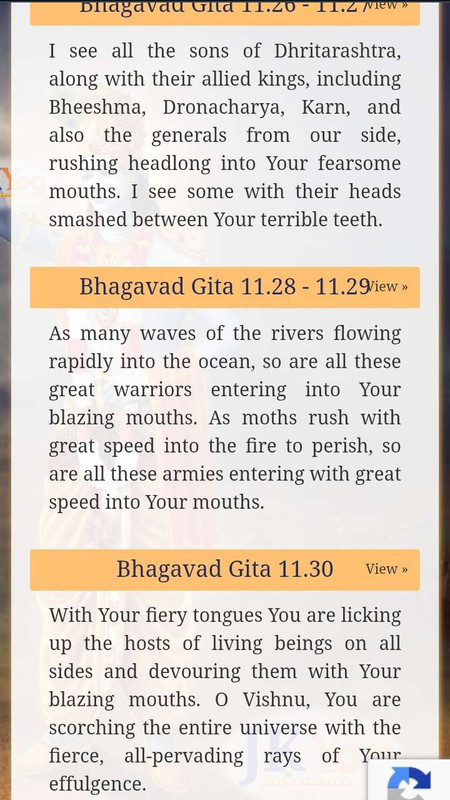
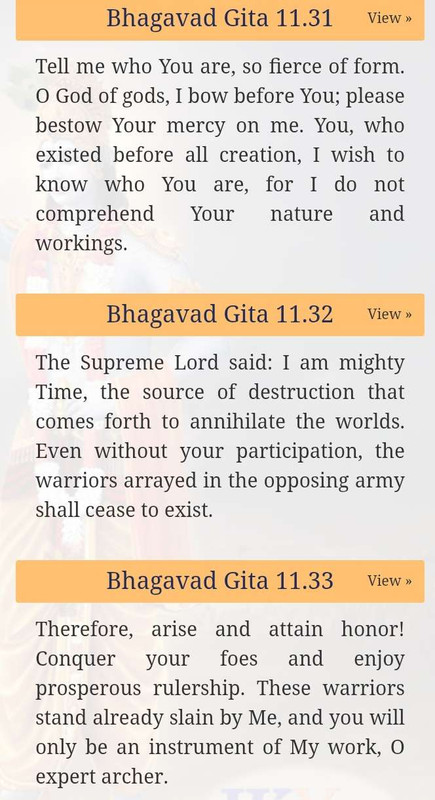
Case in point, how many times would a person need to be dropped on their soft widdle baby head to have something this metal in their holy book but then be like, "nah no thanks, just not for me, I prefer the version where I'm an inconsequential pile of randomly assembled meat and there's nothing else going on out there."
Dying in Hell and Buddhism
8 hours ago
I really love the screenshots you posted, these verses are really awesome!
There's some cool background lore if you're interested about some of the people mentioned in 11.26-11.27
Dronacharya was the teacher of Arjuna and his brothers, along with their cousins. He was on the side of the Kauravas during the war, which was the evil side, but Arjuna felt conflicted about going to war with the very master who taught him how to wield his bow. So Krishna rationalizes it by telling Krishna that his duty is to fight evil, so he has to fulfill his duty even if it means going to war against his relatives. This is basically the entirety of the Gita, it takes place during a brief conversation Arjuna and Krishna have on the battlefield, right before Arjuna goes to war. He loses his courage and his will to fight, so the Gita is a series of meditations and reflections on ethics, duty, and what the meaning of life is even in the midst of battle. I guess for outsiders the conversation is brief, and because some parts exist out of time as perceived by people on the battlefield, since at one point Krishna shows his divine form to Arjuna.
He ends up being so hard to defeat, killing like thousands of their guys that they have to trick him in order to win. Arjuna's elder brother, Yudhistra, is a man who never tells a lie. So they try and distract Drona by lying to him saying that his son, Ashwattama died. But they know that Drona would never believe them unless Yudhistra says its, since Yudhistra is the most honest man alive in the story(of course, he is the one that started all this because of his gambling addiction, but that's a story for another day. I guess the point is that ever character has their flaws and nuances, and no one is truly perfect.)
So they name an elephant Ashwattama, kill the elephant, then have Yudhistra shout, "Ashwattama is dead". Drona gets really depressed and stops fighting.
Bheeshma
Bheeshma is the grandpa of the Pandavas and the Kauravas. He ends up siding with the Kauravas(bad guys) but even then, the Pandavas(good guys) still respect him because he is really wise and gives great advice. He's a demigod, the son of the river goddess Ganga and a mortal king. He ends up taking this vow of lifelong celibacy so that his father and his stepmother could secure their lineage for the throne, and because of that, his father grants him the wish to choose his own time of death. He singlehandedly fights the Pandavas off for 10 days, he's basically the equivalent of Agammemnon, and he's the commander of chief of the army.
He ends up being so good that Krishna, who originally joined the war only to stay in his mortal form and not actually use his god powers, almost breaks his vow because of how frustrated he gets seeing Bheeshma's skill.
They end up having to change their strategy to kill Bheeshma because he was too good for them simply by overwhelming him with numbers. So when Bheeshma was younger, he gets cursed to only be killed by a woman in battle. So no man would be able to kill him. Shikandhin, one of the princes, was a trans man who was previously a woman but through a lot of rituals and penances and magic stuff, becomes a dude and thus was eligible to kill Bheeshma since he was a woman at one point in his life. He was also a princess in her past life who gets reincarnated as Shikandhi to take revenge on Bheeshma, and then Shikandhi goes through the gender-change process and becomes Shikandhin.
So Shikandhin and Arjuna shoot a volley of arrows at Bheeshma and kill him. But since he's able to choose his own time of death, he basically asks Arjuna, as a last favor to his grandpa, to shoot a bunch of arrows in the ground in a really close and precise manner, essentially making him an bed made out of arrows, then he spends like forty days or so sleeping on the arrow bed slowly bleeding out from a bunch of arrows, and gives the good guys advice about life and being a king.
Dying in Hell and Buddhism
8 hours ago
Oh here it all is, I thought the site had glitched. I'd started to split the thread off at the post just above this, then set my phone down a few minutes and ended up just making a new thread with that one single post by the time I came back to it.

